
Helping more job seekers get the best resume support, tailored applications, and career guidance without adding staff
Customer Type: Workforce board, career center, nonprofit employment program, or workforce contractor
Audience Served: Job seekers, WIOA participants, remote participants, career staff, case managers, and program managers
Primary Challenge: Staff delivered valuable resume and career guidance, but manual support, workshops, and in-person services could not reach every job seeker consistently
Jobflow Workflow: Staff invite participant → resume builder → resume improvement → job matching → fit coaching → tailored applications → tracking → staff visibility
Key Outcomes: More people served, stronger resume quality, better remote access, less repetitive staff work, more consistent guidance, and clearer participant reporting
Workforce boards do more than provide training, pathways, and connect people to job openings.
They teach job seekers practical skills on how to present themselves, explain their value, understand career options, tailor resumes, prepare for interviews, and apply with confidence.
That work is essential. But it is also difficult to scale.
Jobflow helps workforce boards multiply that impact by turning the guidance staff already provides into a guided digital workflow job seekers can use on-demand.
The Situation
A capital area workforce development board served thousands of job seekers across a large region. They offer resume workshops, career coaching, job-search classes, and one-on-one appointments, yet still reach only a portion of the people who need help.
Many job seekers never come into a career center. Others may attend one workshop but still need help applying what they learned to real jobs. Staff are left trying to deliver personalized support through limited appointment slots, workshops, emails, and follow-up.
The board’s staff knew what job seekers needed:
- Stronger resumes
- Better job targeting
- More tailored applications
- Clearer career direction
- Help explaining transferable skills
- Coaching on why certain jobs fit
- Support staying organized and following through
- Local job matches
But staff time was limited.
A resume workshop could teach best practices, but each participant still had to apply those lessons to their own background. A career coach could explain the importance of tailoring, but manually helping every participant tailor every resume was not realistic. Remote job seekers, rural participants, working parents, and people with transportation barriers were even harder to reach consistently.
The board needed a way to extend high-quality career support beyond the walls of the career center.
“Jobflow helped us turn the resume and job-search guidance we were already teaching into a scalable workflow every participant could use from anywhere.”
The Challenge
The systems workforce boards are required to use for intake, case management, and reporting, often become the bottleneck because they are manual-heavy and disconnected from services job seekers prefer to use.
Workforce boards are also used to assisting only those who schedule appointments or walk into a career center. The challenge is that is only a fraction of the locals who actually need career assistance, and most participants need individualized help with tasks like:
- Rewriting resume sections
- Tailoring resumes
- Helping job seekers identify realistic roles
- Reviewing job descriptions
- Drafting cover letters
- Coaching participants on fit
- Tracking who is applying and who needs follow-up
That created three practical limitations for the capital area workforce board:
- Reach was limited
The board could only help the people who attended workshops, booked appointments, or came into a center. - Quality varied
Some participants received deep one-on-one support, while others relied on templates or generic advice. - Staff visibility was incomplete
Once participants left the workshop or career center, staff often had limited insight into whether they improved their resume, found jobs, tailored applications, or applied.
The Jobflow Approach
Jobflow gave the workforce board a scalable way to deliver personalized job-search support to every participant, including those served remotely. Instead of relying only on workshops or one-on-one appointments, staff could invite local participants into Jobflow and let the platform guide them through the work.
Jobflow's automated workflow allows job-seeking participants to:
- Instantly build or improve an existing resume
- Translate experience into stronger language that resonates with hiring managers
- Be matched to jobs aligned with their skills and goals
- See a detailed fit breakdown for each role
- Understand gaps and how to address them
- Tailor resumes and cover letters for each job while they use any job site
- Track applications and saved opportunities
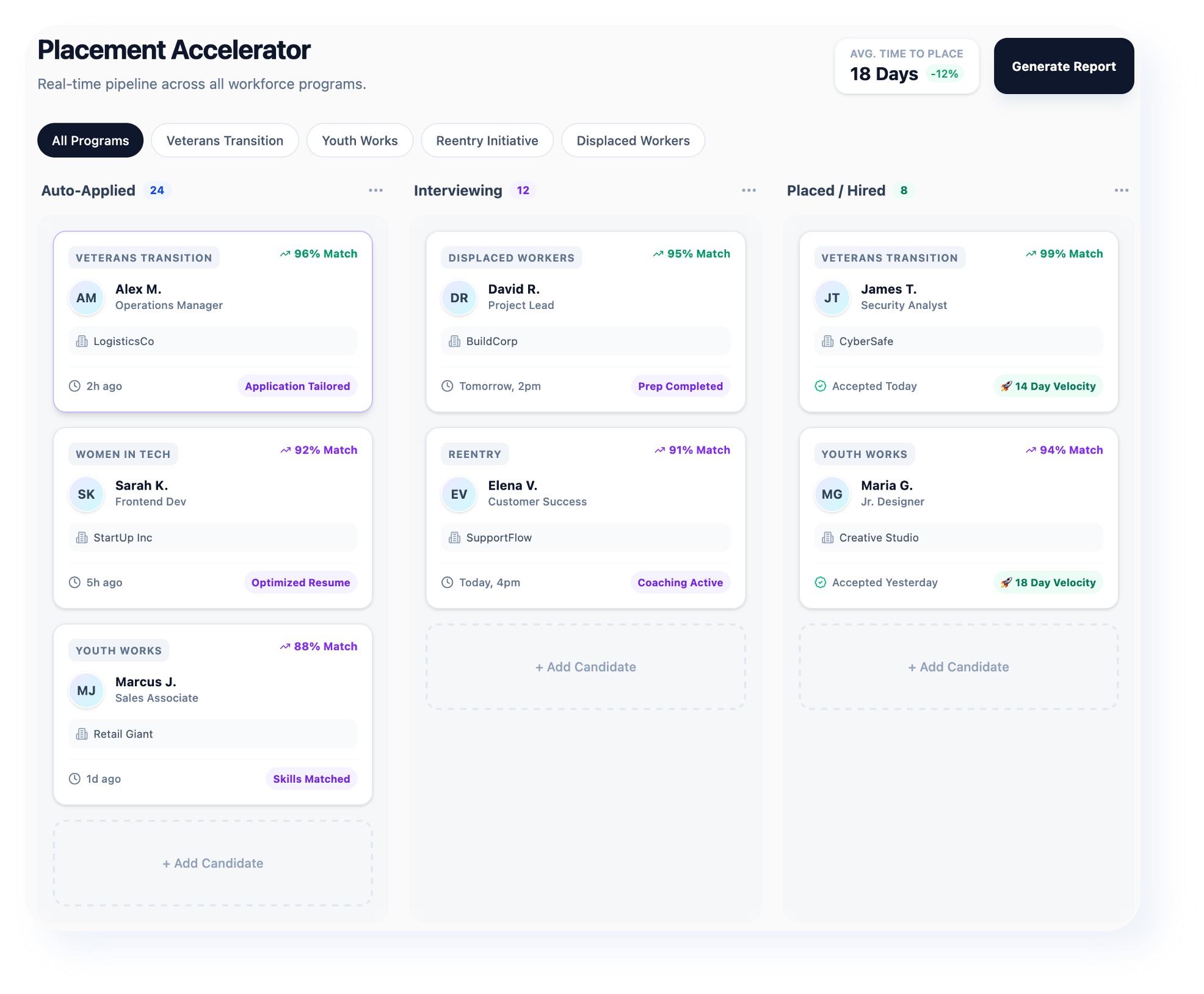
Workforce staff is able to track and monitor all activity from their participants, see who is engaged, how many jobs they have been matched to, who needed the help and during which step in the application process, but no longer have to manually intervene at every step. The time savings allowed them to focus coaching time on higher-value conversations.
The Workflow in Action
One way the workforce board decided to provide Jobflow access was during a hosted resume and job-search workshop for job seekers across the region.
Previously, participants would leave with advice, templates, and encouragement. Some would follow through. Others would get stuck as soon as they tried to rewrite their resume or apply to a real job, and most never sought more help from the career center.
With Jobflow, part of the workshop time was carved out to onboard with Jobflow, and the workshop ended with a clear next step.
Participants were invited by the workshop staff to create an account, build or upload their resume, walk through actionable improvements, and start receiving matched jobs. Those who could not attend in person received the same invitation remotely through email, text, or staff outreach.
One participant had not visited a career center because of transportation and childcare constraints. She had retail and hospitality experience, but had recently been laid off. Her resume was outdated and she was unsure of the types of roles she should go after, how she meet the qualifications, or if she should consider a career pivot to a more in-demand occupation.
Using Jobflow, she simply spoke into the system to describe her career path and qualifications, was able to understand the key transferable skills she had, and was instantly matched to open jobs. Jobflow coached her on her fit for the job openings, created a tailored resume and cover letter for each application, and helped her more confidently launch a new career path.
When staff checked her activity, they could see she had completed her resume, been matched to local opportunities, and generated tailored applications. Their follow-up conversation became focused and practical, which is how they discovered she was already being interviewed by local employers for several opportunities.
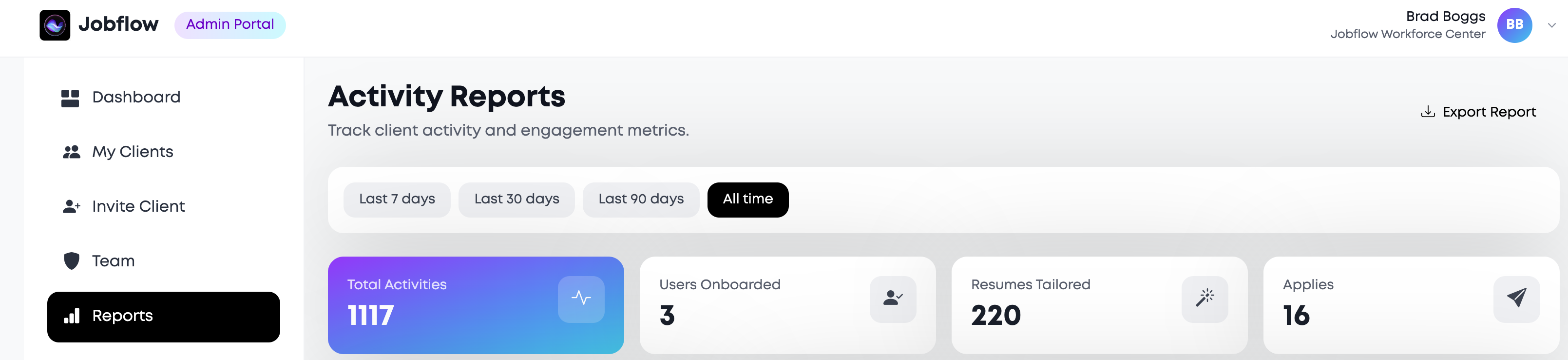
The capital area workforce board emailed us to share this story, and added how they would have missed helping this job seeker in the past, and how we have saved hours and hours of staff time on manual resume and career assistance.
The Results
Jobflow helped the board expand career support beyond the limits of workshops, appointments, and physical career centers.
The board could reach more job seekers across the region, including people who were unlikely to come in person. Participants received consistent, personalized help applying the same career guidance staff already taught. Staff gained better visibility into who was active, who needed help, and who was ready for referral.
The impact included:
- More job seekers supported across the region
- Less staff time spent on repetitive resume writing
- More consistent resume and application quality
- Stronger follow-through after workshops
- Better remote service delivery
- Faster movement from career advice to real applications
- Better visibility into participant activity
- More focused coaching conversations
- Stronger reporting for managers and funders
The board did not replace staff expertise. It scaled it, which means they can help more people without reducing the quality of service.
___
Give career staff an AI-powered workflow that multiplies their impact without replacing their judgment. Try it out for free, or let's set up a demo for your career staff to help multiply their impact.
Jobflow helps workforce boards serve more job seekers across the region with guided resume support, job matching, fit coaching, tailored applications, and staff visibility — whether participants come into a career center or not.


Related posts
Browse all posts


