
Modernizing the participant job-search experience while working alongside required workforce systems
Customer Type: Workforce board, workforce development agency, or workforce contractor
Audience Served: Job seekers, WIOA participants, dislocated workers, youth, adult learners, and career staff
Primary Challenge: Required systems did not provide modern resume support, job-fit coaching, tailored applications, or visibility into participant activity
Existing Systems: State job bank, case management system, workforce center workflow, spreadsheets, employer career sites, and public job boards
Jobflow Workflow: Resume builder → resume improvement → job matching → fit coaching → tailored resume and cover letter → application tracking → staff visibility
Key Outcomes: More scalable participant support, better application quality, faster movement into active job search, stronger staff visibility, and better use of existing workforce systems
Workforce boards are under pressure to help more people move to employment faster (often with reduced budgets!), while still largely operating with the State job bank, case management system, intake process, and reporting workflow they are required to use.
These are necessary. But they were not built to deliver the kind of modern, personalized job-search experience participants now need.
Job seekers need help building stronger resumes, understanding what jobs fit their experience, tailoring applications, and staying organized as they apply across multiple job sites. Staff still need visibility into participant activity, progress, and readiness. Employers still need better-prepared candidates and stronger referrals.
Jobflow helps workforce boards modernize that experience while working alongside the systems they already use. Our platform works over the top of the existing workforce infrastructure, giving participants AI-powered resume building, job matching, fit coaching, tailored application materials, and job-search tracking while giving staff a clearer view of participant engagement and progress.
The Situation
A capital area workforce board was serving fifteen thousand job seekers each year through its existing workforce centers and various programs for youth, adult, and dislocated workers.
The board’s team was committed to helping participants find work, but much of the job-search process still depended on manual support. Participants came in with outdated resumes (if they had one at all), incomplete work histories, unclear career goals, and limited confidence in how to apply for jobs.
The state job bank remained the source of truth for all activity. But the user experience for workforce staff and participants seemed far behind what job seekers find on employer websites, Indeed, LinkedIn, Google, and other job platforms, which is where they preferred to search.
That created a gap.
How do we encourage our customers to use the State site to prove we are helping more people, and how do we actually help them get hired with our local partners?
Participants were using many different tools to search for jobs, but staff had limited visibility into the quality of their resumes, the fit of the roles they were pursuing, the applications they were preparing, or where they were getting stuck.
The Challenge
The challenge was that the job search workflow was fragmented. The workforce team hoped their customers would register and use the State's job bank, while the job seekers preferred to use any number of sources outside the board's required system.
In reality, a participant might create a resume in one place, search for jobs in another, apply through a third-party employer site, track applications manually, and return to staff later with little record of what happened. Staff were left trying to coach, follow up, and report on activity that often happened outside the systems they could see.
At the same time, career staff were spending significant time on repetitive job-search support, including:
- Building or improving resumes
- Helping participants identify realistic job options
- Explaining whether a job was a good fit
- Rewriting resumes for specific applications
- Drafting cover letters
- Encouraging follow-through
- Tracking participant progress
- Preparing participants for employer referrals
The board needed a way to make job-search support more scalable, more consistent, and more visible without disrupting the systems it was already required to use.
The Jobflow Approach
Jobflow was introduced as a modern job-search automation layer that works alongside the board’s existing systems.
Participants could instantly build their resumes or have their existing resume improved, before being matched to jobs from the State job bank, coached on their fit for reach role, and received a tailored resume and cover letter unique to each opportunity in one click. Or, they could also use employer career sites, Indeed, LinkedIn, Google, or any other job source while having all their activity captured by the workforce board.
With Jobflow, participants:
- Build or improve their resume
- Receive ideal-fit job matches
- Understand why each job was or was not a strong fit
- Identify gaps in skills, experience, or positioning
- Tailor their resume for each job
- Generate a personalized cover letter
- Save and track job opportunities
- Organize applications in one workflow
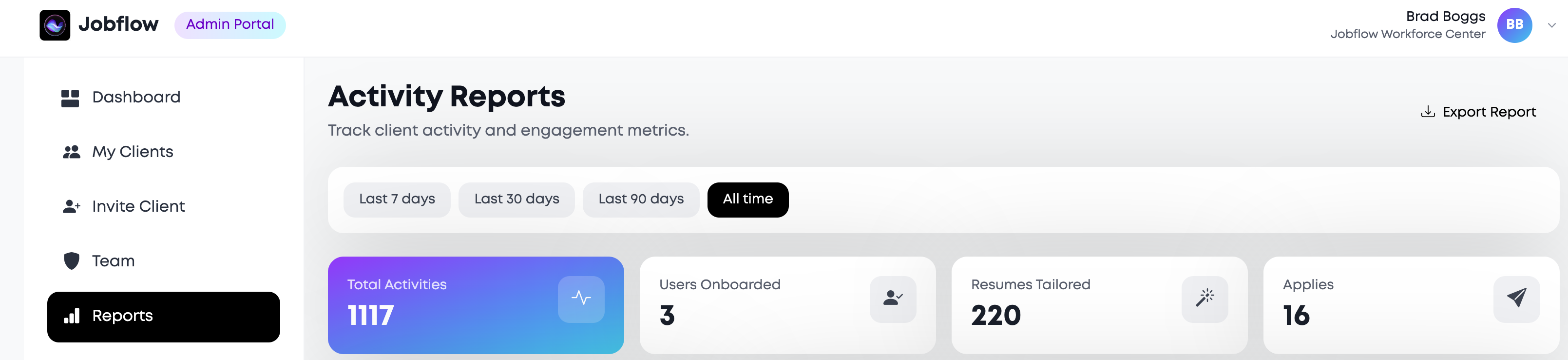
For staff, Jobflow created a clearer picture of participant activity. Rather than relying only on appointments, self-reporting, or disconnected job-search activity, staff could see which participants were building resumes, reviewing jobs, tailoring materials, and moving toward applications.
This allowed staff to focus less on repetitive document creation and more on coaching, accountability, readiness, and placement strategy.
The Workflow in Action
Here is a video demo showing the workflow in action for career staff, job seekers, and workforce boards.
One participant entered the program with an outdated resume and no clear sense of what jobs to pursue. He had been applying to jobs for months, mostly on Indeed, and was yet to even hear back.
He had several years of customer service, warehouse, and team lead experience, but his resume read like a list of duties rather than a strong summary of skills and accomplishments. He was applying inconsistently and mostly searching by job title, which caused him to miss roles that matched his transferable skills.
Using Jobflow, the participant built a new resume from scratch by answering a few questions about his background, experience, and job preferences. Jobflow helped turn his work history into clear accomplishments and value-driven language, emphasizing team coordination, inventory support, and operational problem-solving.
From there, Jobflow matched him to roles that aligned with his background, including:
- Warehouse Lead
- Inventory Coordinator
- Customer Support Specialist
- Operations Assistant
- Logistics Coordinator
- Retail Supervisor
- Delivery Operations Associate
For each job, Jobflow explained why the role fit, what experience to emphasize, and where he might have gaps.
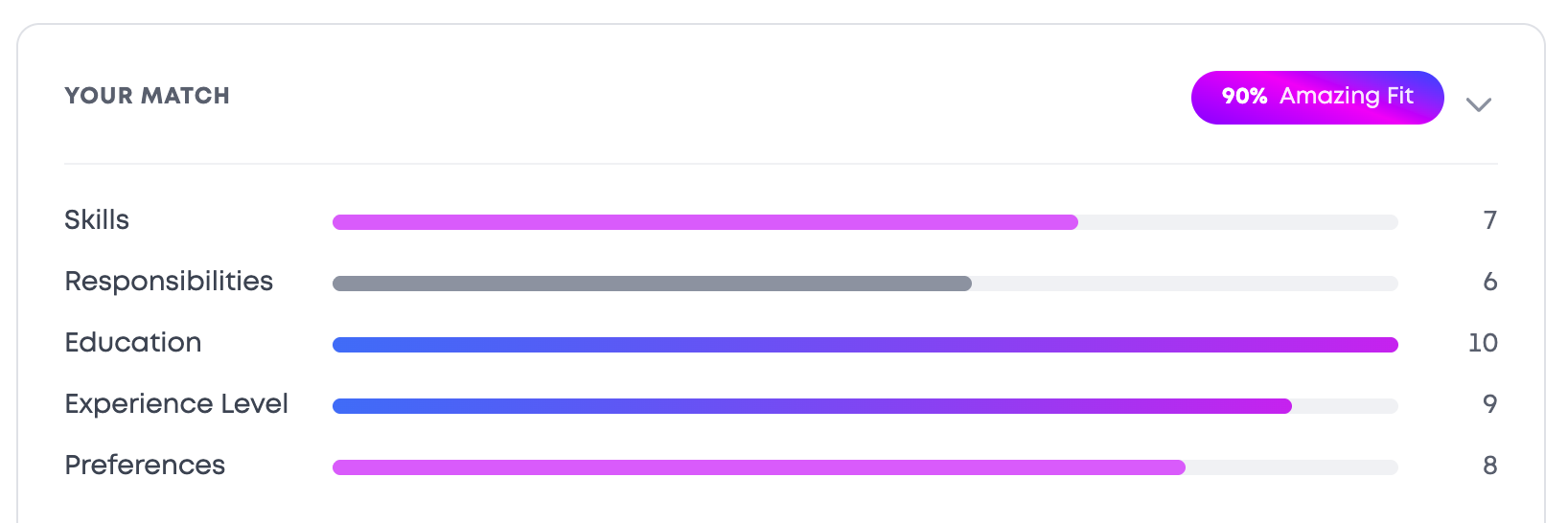
Surprisingly, some of his best-fit roles to which he was matched, were from the State's job bank, where he was redirected to apply after we completed our process of matching, coaching, writing.
The case manager supporting him could see all his activity his resume creation, daily matched jobs, tailored applications, and where he was in the hiring process for different roles. Their next conversation became more focused and productive.
Instead of starting with, “Have you applied anywhere?” the staff member could ask:
- “Do you want to prioritize logistics, customer service, or supervisor roles?”
- "How can I help you prepare for interviews?"
- “Let’s look at the gaps Jobflow flagged and decide how to address them.”
That shifted the staff interaction from basic job-search administration to higher-value coaching.
The Results
Jobflow helped the board improve the participant experience while making staff support more scalable and visible.
By inviting participants to the workforce board's Jobflow platform, participants received more immediate help with the parts of the job search where they often struggle most: resumes, job fit, tailoring, and organization. Staff gained a better view into job-search activity and could prioritize their time around participants who needed additional coaching, encouragement, or referral support.
The impact included:
- More participants supported without adding staff
- Faster movement from intake to active job search
- Stronger resumes and more relevant application materials
- Better job matching based on skills and experience
- More visibility into participant activity outside staff appointments
- More consistent support across participants and locations
- Less repetitive resume-writing burden on career staff
- Better use of the existing state job bank without forcing system replacement
For the board, the value was not simply that Jobflow added another tool. The value was that Jobflow made the existing workforce process more effective.
It helped participants become more prepared, helped staff coach more efficiently, and helped the board create a more modern experience without asking the state to replace its core infrastructure.
Why It Matters
Workforce boards are often told they need to modernize, but they are still bound to legacy systems. State-mandated tools, procurement constraints, reporting obligations, and established workflows. Any new solution has to fit into that reality.
That is why Jobflow’s role is different from a traditional job board or case management system. It helps participants use that system, and every other job-search channel, more effectively.
For workforce boards, that creates a practical path to modernization:
Existing systems stay in place. The participant experience gets better. Staff visibility improves. Job search support scales.
___
Modernize the participant experience without disrupting the systems your board is required to use. Try it today or let's set up a demo to discuss further.
Jobflow helps workforce boards deliver AI-powered resume support, job matching, fit coaching, tailored applications, and activity tracking over the top of existing state job banks and workforce systems.


Related posts
Browse all posts


